When someone you love passes away, you are suddenly expected to make important decisions at the worst possible time. Having a clear death arrangements checklist gives your family a place to start when everything feels uncertain. It does not make the grief any lighter, but it does make the next steps a little clearer.
What Goes Into a Death Arrangements Checklist
There is more to handle than most families expect. This checklist for death arrangements covers the key areas that need attention in the days and weeks following a loss.
Immediate Steps in the First 24 to 48 Hours
The first two days are the hardest and the most time-sensitive. Here is what needs to be done as soon as possible.
- Get the official death certificate. You will need multiple certified copies for banks, insurance companies, and government agencies.
- Tell close family and friends before sharing anything publicly.
- Call a funeral home to start planning the service and decide on burial or cremation.
- Make sure your loved one’s home and belongings are safe and well cared for.
- If a will exists, locate it as soon as possible.
- Contact your loved one’s employer if they were still working to notify them of the passing.
- Arrange care for any pets or dependents your loved one was responsible for.
- Hold off on making any major financial decisions until you have had time to think clearly.
Funeral and Service Planning
This is where your funeral planning checklist comes in. Decisions around the service need to be made early and often involve the whole family.
- Choose burial or cremation based on your loved one’s wishes or religious beliefs.
- Find a funeral home that feels right, ask about pricing, and get everything confirmed in writing before moving forward.
- Plan the service by deciding on the location, date, and speakers.
- Write or gather photos for the obituary.
- Arrange transportation for out-of-town family members if needed.
- Choose flowers, music, and any readings that felt meaningful to your loved one.
- Decide whether the service will be private for close family or open to the wider community.
- Consider setting up an online memorial page so people who cannot attend can still pay their respects.
- Keep a record of everyone who sends flowers or condolences so thank-you notes can be sent later.
Financial and Legal Responsibilities
This part of the process is where many families feel the most lost. It is also where mistakes can cause real problems down the road.
- Notify all three credit bureaus to prevent fraud and identity theft in your loved one’s name.
- Contact banks, credit card companies, mortgage providers, and insurance companies.
- Notify the IRS and Social Security Administration.
- Cancel subscriptions, phone plans, and any recurring payments.
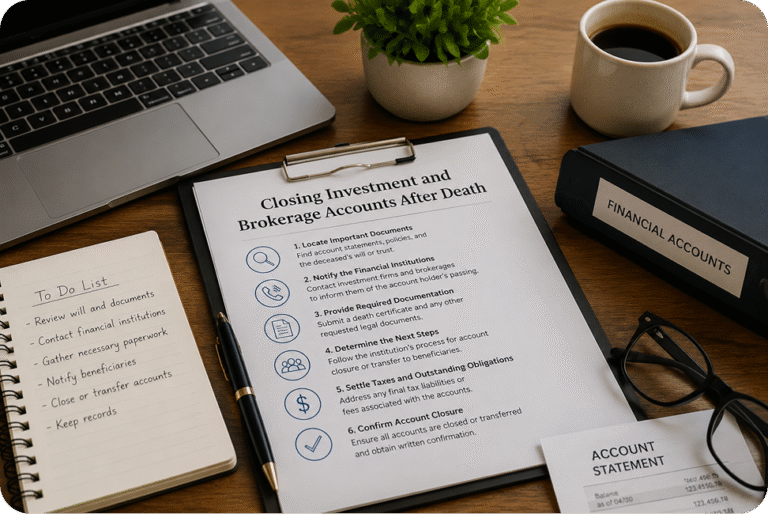
- Reach out to employers, pension providers, and any investment accounts.
- File for any life insurance claims as soon as the death certificate is available.
- Close or memorialize your loved one’s social media accounts according to their wishes.
- Transfer or cancel any vehicle registrations and driving licenses.
- Notify the post office to redirect or stop mail coming to your loved one’s address.
This is also the point in the death arrangements checklist where Final Closures steps in. Instead of making dozens of calls yourself, Final Closures handles all of these notifications for you through a secure online portal. You submit the information once, and they take care of the rest, contacting credit bureaus, financial institutions, government agencies, healthcare providers, social media platforms, and more.
How Final Closures Support Grieving Families
A family bereavement guide can tell you what to do. Final Closures actually does it for you. Their A+ BBB-rated service was built specifically for families who are grieving and overwhelmed. They move quickly, so the window for fraud and financial errors stays as small as possible. And they do it at a fraction of what a traditional estate attorney would charge.
Grief support resources are available in many forms, but very few of them handle the practical side of loss. Final Closures fills that gap by taking the financial and administrative burden completely off your plate.
You do not have to know every step. You do not have to make every call. Final Closures walks with your family through the hardest part of the process so you can focus on healing together.
Reach out to Final Closures today and let them handle what comes next.