Key Takeaways
- Report the death to the SSA as soon as possible.
- Confirm whether the funeral home has already reported the death before contacting the SSA yourself.
- Gather the required documents and identifying information before contacting the SSA.
- Understand that reporting a death and applying for survivor benefits are separate steps.
- Ask about survivor benefits and the $255 death benefit.
- Keep records of all communication with the SSA.
The loss of a loved one is hard, and the legal and financial responsibilities that come with it can make the process afterward daunting. The loss of a loved one is hard, and the legal and financial responsibilities that come with it can make the process afterward daunting. If you’re unsure where to begin, our guide on what to do when someone passes away provides a helpful overview of the next steps.
That said, the first step is knowing how to inform Social Security when someone dies. Timely reporting of the death assists the Social Security Administration (SSA) in correcting its records, discontinuing benefit payments, and determining whether surviving family members are eligible for benefits.
While many funeral homes, hospices, crematoriums, and mortuaries may assist with death notifications, that is not always the case. Understanding what to do and when to do it can help you avoid delays and payment issues, making the process much smoother.
This guide explains why notifying the Social Security Administration is an important part of the post-death process, what information families should have available, and how Final Closures can help simplify the broader notification process.
Table of Contents
Why You Should Notify the Social Security Administration

When you report a death to Social Security, you help ensure the deceased person’s records remain accurate and reduce the risk of benefit overpayments or identity theft.
Prompt notification also allows the SSA to:
- Stop benefits that are no longer payable because of the beneficiary’s death.
- Review whether eligible family members may qualify for survivor benefits.
- Determine whether any additional documentation is needed.
Reporting the death does not automatically start a survivor-benefit claim. Eligible family members may need to contact the SSA separately to apply for monthly survivor benefits or the one-time lump-sum death payment.
Although notifying the SSA is an important responsibility, it’s only one part of settling a loved one’s affairs. If you need support beyond reporting the death, how to notify Social Security when someone dies is just one aspect of the comprehensive post-death notification assistance offered through our Financial Peace of Mind package.
Step 1: Confirm Whether the Funeral Home, Hospice, Crematorium, or Mortuary Reported the Death
Before contacting the Social Security Administration, confirm whether the funeral home involved in the arrangements has already reported the death. The exact process may vary depending on the circumstances.
Does the Funeral Home or Other Similar Organization Notify Social Security?
The simple answer in most instances is yes: the SSA states that funeral homes generally tell Social Security when someone dies, so families typically do not need to report the death themselves.
If a funeral home is not involved or does not report the death, the SSA instructs families to call and provide the deceased person’s name, Social Security number, date of birth, and date of death.
Nevertheless, you cannot assume that this has been done. Confirming with the funeral home can help you determine whether the SSA has been notified and avoid unnecessary duplicate contact.
When the report has not been filed or the organization cannot confirm that it was filed, contact the SSA directly using its current instructions. Families can also review our complete guide on who to notify after someone dies to understand the broader notification process.
Hospices
Hospices sit earlier in the timeline than the others. Hospice teams are often working with a family before a death occurs, during end-of-life care, which puts them in a position to introduce the idea of death notification services ahead of time rather than after the fact. A family that already knows where to turn once a death happens has one less decision to make during an already overwhelming moment, and hospice staff are well placed to make that introduction early.
Step 2: Gather the Required Information
Having important documents and identifying information readily available can help make post-death administrative tasks more manageable. Families looking for guidance can also explore our Essential Foundation package for professional notification support.
For the initial death notification, the SSA says you should be prepared to provide the deceased person’s:
- Full name
- Social Security number
- Date of birth
- Date of death
If you are also applying for survivor benefits, additional information and documents may be required. Depending on the survivor’s relationship to the deceased, this can include marriage information, children’s information, and banking details for direct deposit.
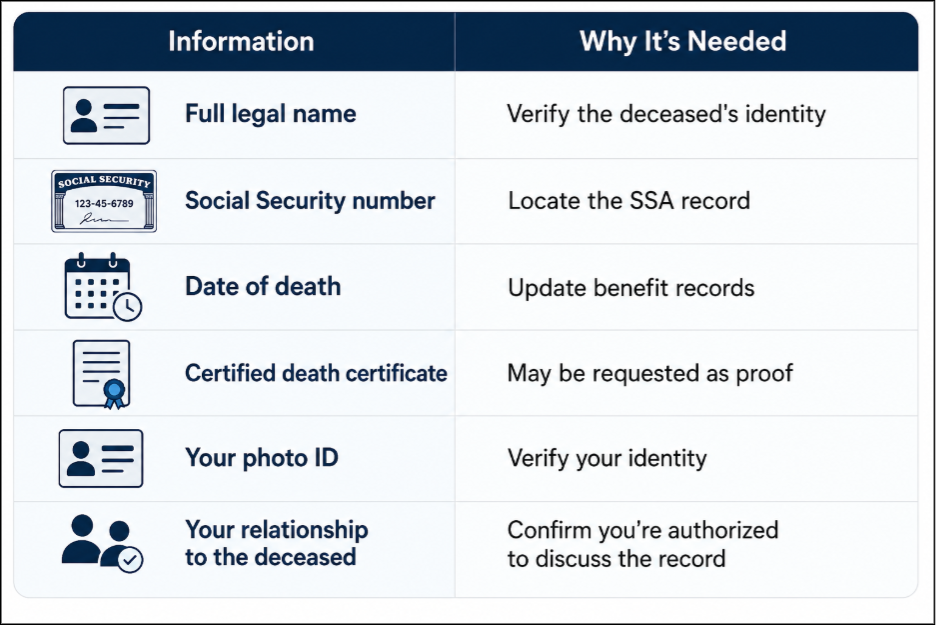
If you plan to ask about survivor benefits, you may also want to keep marriage certificates or birth certificates nearby in case additional documentation is requested.
Step 3: Contact the Social Security Administration
Once you have gathered the required information, the next step is to notify the SSA. The Social Security Administration provides official channels for reporting a death and handling related benefit matters. Families should follow the most current guidance provided by the SSA or work with a trusted service provider for assistance.
When you speak with a representative, explain that you are reporting a death. The Social Security Administration may request information and documentation related to the deceased person and the individual handling the notification. If additional documentation is needed, the representative will explain what to submit and whether you need to visit a local Social Security office.
Can You Report a Death Online?
You generally cannot report a death through the deceased person’s personal Social Security account. If the funeral home has not reported the death, the SSA instructs families to call 1-800-772-1213 or contact a local Social Security office.
Survivor benefits also cannot be applied for online. The SSA instructs applicants to call 1-800-772-1213 or contact a local office to apply.
Be sure to retain any information or confirmation provided during the notification process for your records and find out if eligible family members should begin the Social Security survivor benefits application process.
Step 4: Ask About Survivor Benefits and Payment Rules

Eligible surviving family members may qualify for Social Security survivor benefits. Potential beneficiaries can include a surviving spouse or divorced spouse, unmarried children who meet specific requirements, and certain dependent parents. Eligibility depends on factors such as the survivor’s relationship to the deceased, age or disability, and the deceased worker’s Social Security record.
If eligible, the representative will explain the Social Security survivor benefits application process, the required documents, and the next steps.
Certain eligible survivors may qualify for a one-time Social Security death benefit. The lump-sum death payment is $255 and has specific eligibility and application requirements. In general, a qualifying surviving spouse has priority, while certain children may qualify if there is no eligible spouse. The application generally must be filed within two years of the worker’s death.
What Happens to Social Security Payments?
If you are wondering, “Do you have to return Social Security payments after death?”
For Social Security retirement, disability, and other Title II benefits, no payment is due for the month of death, even if the person dies on the last day of the month. Social Security benefits are generally paid one month behind, so a payment received after death may represent the month of death and may need to be returned.
For example, if a Social Security beneficiary dies in June, a payment received in July may represent the June benefit and would generally need to be returned. SSI has different payment rules, so families should confirm the type of benefit before returning funds.
If you’re unsure whether a payment is payable, contact the SSA before using the funds. If the payment was deposited directly into a bank account, the financial institution may also need to be notified.
Common Mistakes to Avoid
Avoiding a few common mistakes can help make the notification process smoother.
- Assuming the funeral home reported the death: Confirm whether the funeral home submitted the notification.
- Delaying your report when the funeral home did not report it: Contact the SSA as soon as possible.
- Confusing the payment date with the benefit month: A payment received after death may represent a prior month, so check which benefit period the payment covers before using or returning it.
- Using payments received after death: Check with the SSA before spending unexpected deposits.
- Assuming death notification automatically starts survivor benefits: Eligible family members may still need to apply for survivor benefits.
- Overlooking the $255 death payment: Ask whether a qualifying spouse or child may be eligible.
- Not keeping records: Save confirmation numbers and notes from your conversations with the SSA.
Taking these simple precautions can help you avoid unnecessary delays and confusion.
Complete the Process with Confidence
Knowing how to notify Social Security when someone dies can help you avoid benefit overpayments, keep records accurate, and make sure eligible family members know what steps are required to apply for survivor benefits. Whether a funeral home reports the death or you contact the SSA directly, taking the right steps early can make an already difficult time a little more manageable.
Be sure to gather the necessary information, confirm the death has been reported, review any payments received after the death, and ask the SSA about survivor benefits and the $255 lump-sum death payment.
Need help managing post-death notifications?
Final Closures helps families initiate notifications across financial institutions, government organizations, healthcare providers, and other relevant entities. Visit our website or follow our social media channels to learn more about our services and service packages.
Frequently Asked Questions
1. Does the funeral home, hospice, crematorium, or mortuary report the death to Social Security?
Funeral homes generally notify Social Security when someone dies. If a funeral home is not involved or does not report the death, the SSA says the family should contact the agency directly.
2. What is the phone number to report a death to Social Security?
The SSA death notification phone number is 1-800-772-1213. TTY users can call 1-800-325-0778.
3. Do I have to return the Social Security payment for the month of death?
Generally, yes. Social Security retirement and disability benefits are not payable for the month of death. Because benefits are generally paid one month behind, a payment received after death may represent the month of death and may need to be returned. SSI follows different payment rules.
4. What is the $255 death benefit?
The Social Security death benefit is a one-time $255 lump-sum payment for certain eligible survivors. A qualifying spouse generally has priority, while certain children may qualify if there is no eligible spouse. An application generally must be filed within two years of the worker’s death.
5. How quickly should I report a death to Social Security?
You should report a death to Social Security as soon as possible when the funeral home has not already done so. Prompt notification helps SSA update its records and address payments and survivor-benefit questions.
6. Can I get survivor benefits from my spouse’s Social Security?
You may qualify depending on factors such as your age, disability status, marital relationship, and the deceased spouse’s Social Security work record. Surviving divorced spouses and certain children or dependent parents may also qualify.